“Your Will Be Done” (Part 1 of 3)
Ministries > Truth For Life with Alistair Begg
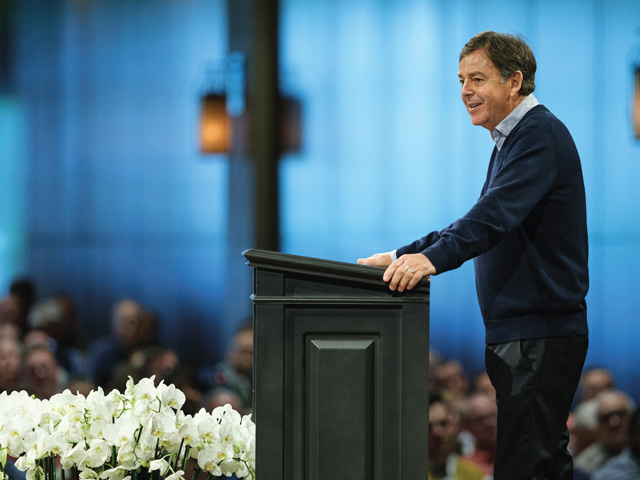
| Do Daniel’s apocalyptic visions alarm you and make you anxious? Daniel himself was confused and terrified by what he saw. Nonetheless, Scripture assures us that believers can be comforted. Find out why when you listen to Alistair Begg on Truth For Life. |
References
Alistair Begg: When you read the apocalyptic visions in the book of Daniel, do they alarm you? Do they make you anxious? If so, you're in good company. Daniel himself was confused and terrified by what he saw. But we can take heart. And today on Truth For Life, Alistair Begg explains why believers can be comforted. Let's open our Bibles to Daniel chapter 8.
Alistair Begg: I confess that in these studies, in my own personal study, I have derived significant encouragement from the reaction of Daniel to the visions he records. Look at how chapter 7 ended for us. It ended with Daniel looking pale, feeling alarmed, and keeping his thoughts to himself. After he had gone through the process. You say, well, how did he do in chapter 8? Well, look at the end of chapter 8.
Alistair Begg: And I, Daniel, was appalled. I was overcome. I took to my bed for a good while, and I didn't understand the vision.
Alistair Begg: I find that wonderfully encouraging. Because there's a couple of times this week where I've just gone to my bed as well. And my wife can testify to that. My desk is sitting there. It's got paper all over it, an odd Bible here and there, and she says, "Are you just going to leave it like that?" I said, "Yes." What else can I do? I don't understand it any better than three hours ago.
Alistair Begg: So I just took to my bed, covered my head with a blanket, and said, "I'll try it again in the morning." Well, that's apparently what Daniel was doing.
Alistair Begg: And if it is daunting to try and teach it and understand it, it is nothing compared to the burden that was laid upon Daniel in order to proclaim it. Because what you have here is Daniel who is aware of the fact that the exile is about to end, because remember, he's now deep into his 70s, maybe in his early 80s.
Alistair Begg: And he knows that both Isaiah and Jeremiah have told that the exile will last for a period of 70 years. So he knows that we're going to be going back to Jerusalem.
Alistair Begg: But what he now knows, as a result of these visions, is that the returning exiles and subsequent generations are not going to have it all their own way. When they are finally put back in the place from which they have been torn, the events that are described here are going to befall them. And the opening two verses set the scene. They set the scene.
Alistair Begg: In the third year of the reign of King Belshazzar. Well, you remember that chapter 7 begins in the first year of the reign of King Belshazzar. So we know that this vision has been given to him two years after the panoramic vision of verse 7. In chapter 8, he now has been given a vision which is part of that panoramic, but focuses only on two distinct elements of the overarching whole that has been provided there in chapter 7. And it will help you if you keep that in mind.
Alistair Begg: He sees himself in Susa. In other words, in this vision, he finds himself somewhere other than he is. He's not in Susa. Susa was 220 miles east of Babylon, 150 miles north of the Persian Gulf, in what is today southwestern Iran.
Alistair Begg: All right? So Daniel, five centuries before Christ, has this vision, and in his vision, that's where he is. Susa was a strategic place, the winter residence of the Persian kings and the administrative capital of the empire under Darius.
Alistair Begg: And it is in that context, you will notice, that he sees. And the emphasis here on seeing is obvious. Verse 2: "And I saw in the vision. And when I saw, and I saw in the vision. Verse 3: And I raised my eyes, and I saw, and behold. And verse 4: And I saw the ram charging." You say, well, why are you making a fuss about this?
Alistair Begg: Well, I'm not actually making a fuss about it, but I want to reinforce for us again that when we read our Bibles and we deal with it in the genre of the text, the way in which the Scripture is given to us.
Alistair Begg: This particular apocalyptic material is provided in such a way that we are supposed to in reading it, in taking it to ourselves, we're supposed to be brought underneath the jurisdiction of the text, in the sense that it calls for us to see.
Alistair Begg: Right? It calls for us to see, it actually calls for us to hear, and it calls for us, if you like, to feel the sense of the impact. In other words, it is a different way of describing things. It is a descriptive methodology for taking us into the realm of the indescribable.
Alistair Begg: And that's why you have these dramatic pictures which are provided. Now, we quoted from Chesterton before, but only the end of the poem. I went to look for the rest of the poem, and it's even better with the first part. Remember Chesterton, writing in the forward of a children's book, put this poem there.
Alistair Begg: This is the sort of book we like, for you and I are very small, with pictures stuck in anyhow, and hardly any words at all. You will not understand a word of all the words, including mine. Never you trouble. You can see. And all directness is divine. Stand up.
Alistair Begg: And keep your childishness. Read all the pedants' screeds and strictures, but don't believe in anything that can't be told in colored pictures. Right?
Alistair Begg: So I said to you that I think I can probably do better through in the children's wing with Daniel 8 than I can do with some of us in here. Because we will not allow the text to do what the text is there to do, to cause us, first of all, to see, to hear, to get underneath the weight of it.
Alistair Begg: Some of you, and I mentioned this in passing, but some of you have never really been able to deal with the apocalyptic passages because you never got the picture. Because you fiddled around with inconsequential, inexplicable details, thereby missing it entirely.
Alistair Begg: Well, I don't know how far we'll get this morning, but we'll get as far as we can. And we'll notice, first of all, that there was a ram, and it had two horns.
Alistair Begg: I raised my eyes and saw, and behold, a ram standing on the bank of the canal, and it had two horns, and both horns were high, but one was higher than the other, and the higher one came up last.
Alistair Begg: Well, if you've been tracking, you say to yourself, I think we've had an inkling of this before. We had that, that creature where one side was, it was leaning on the one side. One side was higher than the other, that's exactly right. And one horn, the one that comes out latter, is seen higher than the other. The kingdom of Medo-Persia, where eventually Persia supercedes the Medo part of it, and triumphs in this immense way, so that Persia rules.
Alistair Begg: You say, "Well, where'd you get that from?" Well, verse 20.
Alistair Begg: As for the ram that you saw with the two horns, these are the kings of Media Persia.
Alistair Begg: You don't have to be a genius. You just have to read your Bible. All right? Now, the ram represents this empire. The higher part of the horn representing the dominance of Persia.
Alistair Begg: And I saw the ram charging westward, northward, and southward. You read of the story of history and you find that these are the movements of the Persians as they conquered in their day. They were apparently invincible. No beast could stand before him. There was no one who could rescue from his power. He did as he pleased, and he became very great. All right?
Alistair Begg: So, verse 4 covers a tremendous chunk of time and a significant amount of geography. But the details of it are not provided for us there because we don't need them.
Alistair Begg: This is where the empire went. This is how the empire conceived of itself. This is the way in which it dominated the then known world. He had seen the collapse of the Babylonian Empire. It was a done deal.
Alistair Begg: And God had pulled back for Daniel a little part of the curtain to give him a glimpse of the purposes of God. So, verse 4 ends with a picture of invincibility, of a sort of unfettered greatness. But verse 5 begins as I was thinking about this, as I was giving it some thought, there appeared in my vision a male goat, actually, literally, a hairy goat, from the west, came across the face of the whole earth, and it was as if it never even touched the ground in its movement.
Alistair Begg: And the goat had a conspicuous horn between his eyes. Now, what is this? Well, verse 21 will help you. And the goat is the king of Greece, and the great horn between his eyes is the first king. In other words, is a reference to Alexander the Great. History records it.
Alistair Begg: Incidentally, prophecy in the Bible is not always future for us when we read the Bible. This prophecy was future for Daniel, but it's history for us. Right? But that's not a surprise because Isaiah 53 was future for Isaiah, but it is history for us who in the person of the Lord Jesus have been introduced to the one who is the suffering servant.
Alistair Begg: In the same way that the prophecy of Isaiah, concerning a virgin who will conceive and bring forth a son, is future for Isaiah, it is history for us. And in this we find that Daniel has been given an insight into what awaits those who are going to come after him. We then are able to read it with the ability of hindsight and put together some of the pieces that were inexplicable to those who were in the middle of it.
Alistair Begg: It is, incidentally, a testimony to the truthfulness of the Bible. Can God, five centuries out, make these kind of predictions and be true? Did God actually give to Daniel a revelation that Daniel could not actually fully get his head around, that was going to prove the reality that it did? The answer is yes.
Alistair Begg: In fact, this is one of the evidences of the fact that the Bible is true, that that which is prophesied comes to fruition. But those who deny the Bible and deny God come to chapter 8 and say, "This can't happen. God can't do this." Therefore, what we have in chapter 8 is material that was written after the events that are described, otherwise, nobody could ever describe them.
Alistair Begg: You see the difference between bowing down underneath the authority of God's Word as provided, and setting ourselves up as an authority over God's Word to determine what can and cannot be, what happened and what didn't happen.
Alistair Begg: And this male goat, with the conspicuous horn, came to the ram with the two horns, which he had seen standing on the bank of the canal, and he ran at him in his powerful wrath. This is what I'm saying to you that you got to get underneath this. That that, I don't think you can read this and go, "Oh, that's very interesting." You've got to read it and go, "Oh, I'm glad, I'm glad I wasn't there for that."
Alistair Begg: You've seen it on National Geographic when these things go at each other. Or you've even been in a field somewhere, and you've seen it actually happen. And the way in which they just go at each other. I mean, you recoil from it. You can hear the noise almost, can't you, of these horns going at one another, hitting one another. You're supposed to. You're supposed to.
Alistair Begg: I mean, why should Daniel be the only one who's appalled and freaked out and has to go to his bed? You're supposed to sit here and go, "Oh, that's very interesting." No, you're supposed to go, "Oh, that's amazing." The kingdoms of the world clashing against one another, one superseding the other, one to rise up invincible, the power of the great king, or whoever it is, and then eventually history comes around and he's gone.
Alistair Begg: You see, only God's kingdom is an everlasting kingdom. Only God's majesty is untrammeled majesty. Man, as man, continues to believe, "We will fix it, we will get it right and so on." But no, look how the mighty are fallen. The ram, who at the end of chapter 4, was apparently invincible, the Persian Empire, who could, nobody could rescue from the power of the Persian Empire. The king did his exactly as he pleased in verse 4.
Alistair Begg: But now we find that the same ram had no power to stand before the goat. The goat cast him to the ground. The goat trampled on him, and there was no one who could rescue from his power. And the goat became exceedingly great.
Alistair Begg: You see, Alexander's victories are recorded well in history. Some of us had to try and study it at history. And the story here of Alexander's movements, you see, it was almost as his feet never touched the ground. When you read the conquests of Alexander, you realize that to that point in history, nobody had been as amazingly and dramatically and quickly victorious as Alexander had been. Within a decade, when he was still in his 20s, he ruled the world.
Alistair Begg: By the time he was 26, he had won these amazing battles, in his 20s. And you can find them recorded, one of them, the Granicus, at the Granicus River in 334 BC. Alexander takes 35,000 of his troops, and he goes against the Persian Empire, 100,000 foot men and 10,000 horsemen. And Alexander's forces killed 20,000 of the opposition to the loss of only 100 Greek soldiers.
Alistair Begg: That was then in turn followed by two amazing victories that established his territory and said, "Alexander is just absolutely on top of the world looking down on creation." He was a hero at 29. He was dead at 33. And the story of his death is a reminder of the fact that he ends in utter humiliation.
Alistair Begg: You see, we're slow to pay attention to this, aren't we? As for man, his days are like grass. And the glory of man is like the flower of the field. The grass withers and the flower falls, the wind blows over his place and he remembers it no more.
Alistair Begg: Because you see, it is the Ancient of Days, God himself, in chapter 7, who says, "Isaiah brings princes to nothing and makes the rulers of the earth as emptiness. Scarcely are they planted, scarcely sown, scarcely has their stem taken root in the earth, when he blows on them and they wither, and the tempest carries them off like stubble."
Alistair Begg: So, Alexander, at the height of his confident, self-proclaimed magnificence, is reduced to a state of utter humiliation, and portents and tales of intrigue and poison surround his death. Apparently, they found him dead in the palace of Nebuchadnezzar in Babylon. And he who is the great man of the day is then replaced. The great goat became exceedingly great, but when he was strong, the great horn was broken.
Alistair Begg: It's a story of history. It's the story of the Bible, actually. It's a story of the fact that God doesn't give his glory to anybody else. It doesn't matter if you're a politician or a pastor. He doesn't, he doesn't share it. Why would he share it? He's God. You see, the seeds of Alexander's demise were grounded in the fact that he was so phenomenally great. But he believed that his magnificence was all of his own.
Alistair Begg: And the great horn, when the great goat, when he was strong, the great horn was broken, and instead there came up four conspicuous horns. Now, we'll have to come back to this. Let me finish in this way. Read history and you know that when Alexander the Great died, there were four generals that took over under him, managing all of the stuff that he had been lord over. Cassander, who ruled over Macedonia and Greece; Lysimachus, over Thrace and Asia Minor; Seleucus, over Syria and Mesopotamia; and Ptolemy, remember the Ptolemies, over Egypt.
Alistair Begg: And out of the four, out of one of them, verse 9, and history records this as well, came a little horn, which was, which grew exceedingly great. Some of you are going, "Oh good, we're back on familiar territory. We remember the little horn from chapter 7." Well, I got bad news for you. This is a different little horn. In chapter 7, the little horn represents the Antichrist. In chapter 8, the little horn represents Antiochus Epiphanes, who embodies all the characteristics of man's rebellion against God.
Alistair Begg: And once again, this little horn grows exceedingly great and and and goes to to amazing extent in opposition to God and his people. And to that, to that we will have to come back. So, how can how can we stop? Well, you just stop. But I mean, how how can I end this just now as it were prematurely?
Alistair Begg: Let me tell you what I wrote down for myself. I reminded myself that this vision is given to Daniel to forewarn Israel about a period of severe persecution, which is going to come in the future, and to assure them that their sovereign God will limit the days of persecution and destroy the persecutor. That's, that's what is conveyed in this vision. That's why Daniel writes it down, so that when all of this unfolds, the people will be enabled to say, "But wait a minute, this is exactly what God said would happen."
Alistair Begg: Don't you think that that is pretty similar to the way in which Jesus prepared his disciples as well? "I have said all these things to you to keep you from falling away. They will put you out of the synagogues. The time is coming when whoever kills you will think he's offering a service to God, and they will do these things because they haven't known the Father or me. But I have said these things to you that when their hour comes, you may remember that I have told them to you."
Alistair Begg: So God is doing the exact same thing now, all of these periods of time before the coming of the Lord Jesus. And the function of chapter 8, the function of the whole, the whole section is not for our calendar, but for our comfort. That's number one. It's not for my calendar, it's for my comfort. So if I go calendar, I miss the, I miss why it's there.
Alistair Begg: Secondly, God knows what's up. I was at a black church in Jacksonville this week, and many of the brothers said to me, "Hey man, what's up? What's up?" And I said, "You know, God knows what's up." Also, God is at work behind the scenes. Therefore, stay steady. Be prepared. And it's not over until it's over. And it's not over. And the reason it's in here is so that we might understand that the God who looked after his rebellious children five centuries BC, is the same faithful, sovereign God that will look after his rebellious children 21 AD. Take heart.
Alistair Begg: You're listening to Truth For Life. That is Alistair Begg with an assuring reminder of God's sovereign power over all things and his providential care for his people in all circumstances.
Alistair Begg: You know, the more you know about Jesus, the easier it is to rest in his care in troubled times. So to help you know him better, we're offering two books, written by 17th century Puritan minister John Flavel. The books are titled Christ and His Threefold Office and Christ Humbled, Yet Exalted.
Alistair Begg: These books will guide you into a deeper understanding of who Christ is and what roles he plays in every Christian's life, from our mediator before God to our source of salvation and spiritual life. Ask for the John Flavel Two-Book Bundle when you make a donation to Truth For Life today. You can give online at truthforlife.org/donate or call us at 888-588-7844.
Alistair Begg: Thanks for listening this week. Does this study of Daniel's prophetic dreams make you want to share the gospel with more people? On Monday, we'll find out why it should.
Alistair Begg: The Bible teaching of Alistair Begg is furnished by Truth For Life. For the learning is for living.
Related Episodes
“Your Kingdom Come” (Part 2 of 2)
Thursday, July 23
“Your Kingdom Come” (Part 1 of 2)
Wednesday, July 22
Getting the Picture (Part 2 of 2)
Tuesday, July 21
About Truth For Life
Truth For Life distributes the unique, expositional Bible teaching of Alistair Begg. Studying God’s Word each day, verse by verse, is the hallmark of this ministry. In a desire to share the good news of the Gospel without cost as a barrier, the entire teaching archive is available for free download and resources are available at cost with no markup.
About Alistair Begg
Alistair Begg has been in pastoral ministry since 1975. Following graduation from The London School of Theology, he served eight years in Scotland at both Charlotte Chapel in Edinburgh and Hamilton Baptist Church. In 1983, he became the senior pastor at Parkside Church near Cleveland, Ohio. He has written several books and is heard daily and weekly on the radio program, Truth For Life. The teaching on Truth For Life stems from the week by week Bible teaching at Parkside Church. He and his wife, Susan, were married in 1975 and they have three grown children.Contact Truth For Life with Alistair Begg
Website
http://www.truthforlife.org/?utm_source=oneplace&utm_medium=sitelinks&utm_campaign=home
Mailing Address
Truth For Life
P.O. Box 398000
Cleveland OH 44139
Telephone (Customer Service)
888-588-7884 Domestic
400-543-6800 International
440-543-0522 ( Fax)